



The UN is collectively experiencing rapid adoption of emerging technologies, while finding ways to evolve and strengthen its system from within, as part of the UN 2.0 push towards new ways of working and digital capabilities for a future-ready UN. Globally, creative AI tools have surfaced as a solution that enhances efficiency and technical capability, helping organizations like ours to address challenges faster, with less.
While there is agreement that creative AI can contribute positively to a myriad of initiatives, concerns such as bias, threats to human rights and climate impacts are also exacerbated. AI as a technology doesn’t exist in a vacuum — it exists in a world where systemic inequalities pre-existed, and with technology moving so fast, it is outpacing the governance required to ensure responsible and ethical deployment. As an organization that champions values-based innovation, the UN needs to align how we approach creative AI with inclusiveness and responsibility that has defined our work for generations.
How do we approach creative AI tools through a critical and ethical lens — with intention, and with awareness of what they cost and whom they serve?
UN Global Pulse is partnering with Liminal, a design futures consultancy that uses design methodologies to imagine, explore, and create future possibilities. Together, our inquiry untangles and puts into practice critical lenses we can use to embrace accountability in our explorations with such tools.
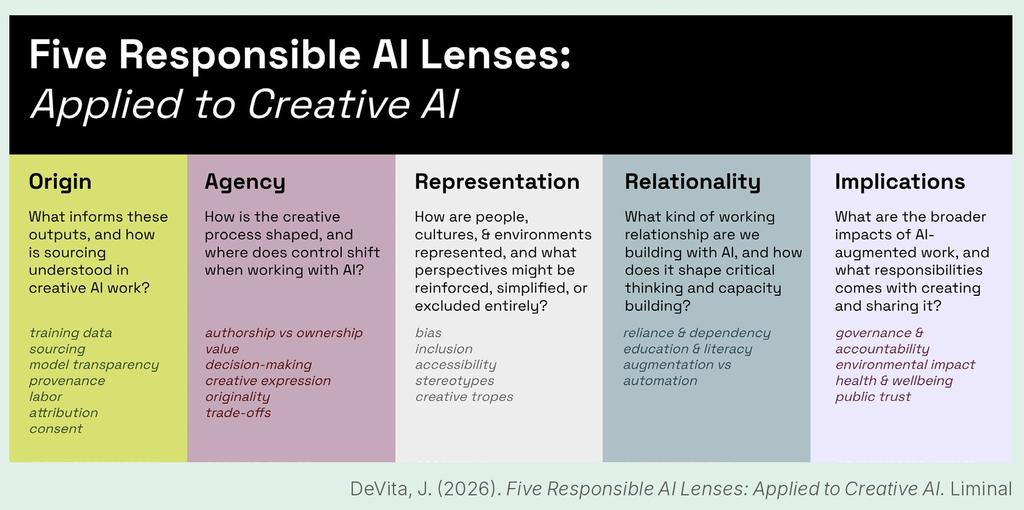
Through a workshop, we will be creating a space where UN colleagues can generate, critique, and iterate on images created using creative AI tools, and define how UN values and ethics show up in that process. We will introduce and apply Liminal’s five Responsible AI lenses — Origin, Agency, Representation, Relationality, and Implications — as a practical framework for examining AI-generated outputs.
In doing so, we hope to build a shared vocabulary and a small community of practice for colleagues working through the same questions about creative AI. The goal is to build ethical competency with such tools through structured, hands-on play, and to prompt UN personnel to find ways to align UN values in the outputs they generate. This work speaks directly to the UN 2.0 agenda: embedding new ways of working and strengthening our digital capabilities to be future-fit as an organization.
Conscious, Creative, Critical: How We’re Designing the Workshop
Our approach draws on insights from our 2023 report, The Most Creative Look to the Future: Imagination and Creative Practice in Service of Organization Transformation, and the Creative Practice Competency Framework we published alongside it. As part of this inquiry, we are leaning into two of the competencies from that framework in particular: ‘Exploring’ — pushing boundaries to investigate possibilities, challenge paradigms, and understand ambiguity — and ‘Building’ — prototyping, rehearsing, and manifesting alternative ways of being, collectively.
By designing a space that lets us sit with ambiguity, ask provocative questions, and prototype iteratively and practice alternative ways of approaching our work, we can intentionally engage with AI tools and strengthen our capacity to approach them through a critical and ethical framework. Through structured play and a hands-on approach, participants define how to integrate values and ethics within that process.
Leading the workshop is Julienne DeVita, founder of Liminal and a design futures practitioner. Through years of teaching and researching AI ethics, Julienne developed the five Responsible AI lenses as a critical framework that offers a practical way to examine the outputs of generative AI and guide its use.
To ensure our inquiry is rooted in responsibility from the start, a conscious choice was made to host the workshop on Adobe Firefly — a model trained to use licensed assets, open source media, and public domain content.
An invitation to explore being a human in the loop
Engaging with AI responsibly is not a one-time experience. It is an ongoing process, a negotiation of unlearning and relearning as we evolve with these technologies — a loop within our creative practice that asks us to review, revisit, and reckon with our collaboration with AI.
This workshop uses creative AI tools as an entry point into exploring the mindsets and behaviours we hope to build — sitting with ambiguity, comfort in asking provocative questions and seeking support from these tools with intention — but they are not tied to just AI tools. We hope this practice extends beyond creative AI, into how UN staff approach most emerging technologies with the same ethics and responsibility.
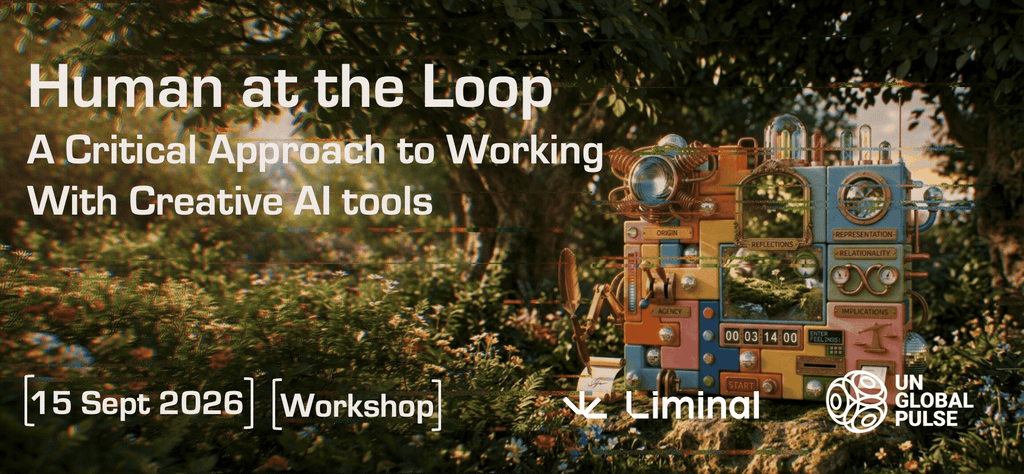
If you are working within the UN system, join us as we explore this loop together, within a structured workshop designed through models of play and experimentation. The workshop will take place on 15 September 2026, and you can express your interest in participating through the form below.
The workshop is open to UN staff. You don’t have to be an AI specialist or a designer to join. Curious researchers, communicators, and programme officers are all welcome. The final group of participants will be made up of a dynamic and diverse group of colleagues, representing different areas of work, regions and skillsets to ensure that different perspectives and experiences can shape this workshop. Please note that participation requires a firm commitment to attend and engage for the whole session, as space is strictly limited to 35 seats only.
Stay tuned for insights from the workshop, and for how we continue tending to our creative practice in the time beyond it.