


At UN Global Pulse, we keep returning to a simple but difficult question: what does change actually look like in practice? And more importantly, as we support new approaches and transformation across the UN, what might we miss about change because of how we define and measure it? How might we define and measure change from the very start of an innovation project, rather than at the end?
Our work with the Resident Coordinator’s Office (RCO) in Colombia let us test those questions. In 2025, RCO Colombia, which coordinates the United Nations’ work in the country, launched its Localization Initiative to contextualise the implementation of the UN Cooperation Framework to local realities. Broadly speaking, the Cooperation Framework is the UN’s instrument for shared planning and implementation at country level. In Colombia specifically, the Localization Initiative was established to bring that planning to the territorial level by facilitating coordination with local governments, civil society, and communities to co-develop what the country team referred to as Territorial Action Plans (TAPs). This aimed to shift planning away from centrally made decisions in Bogotá and distribute power to territories like Cauca, Guaviare, and La Guajira. By building these plans jointly, the RCO created a fundamental systemic shift in how the CF is planned and delivered.
The planning changed, but it remained unclear whether this new way of planning actually changed how agencies, and the people in them, collaborated. Were colleagues coordinating differently? Was there more trust? Were decisions being made together, rather than in siloes which previously slowed down effective planning?
Traditional UN projects and planning often do not account for these detailed changes, even though they remain critical to understanding the real impact of our work. Traditional monitoring, evaluation, and learning (MEL) methods do not always capture shifts in mindsets, decision-making, or behaviours. While there is a heavy emphasis on tracking outputs, activities, and key metrics, important signals of change can fall through the cracks. This is where behavioural science methods are particularly imperative. Combining MEL and behavioural science is not new per se, but applying them together to inter-agency, territory-level planning was an important experiment in our collaboration with the RCO in Colombia.
Our collaborative project with the RCO responded to a clear gap between planning models that worked on paper and evidence of whether people were actually working differently because of them. Together with the RCO team, UN Global Pulse’s MEL and Social and Behavioural Change teams were less interested in whether the model made sense but more interested in whether deeper signs of change were taking shape on the ground, including shifts in trust between colleagues and agencies, coordination habits, and motivation for shared decision-making, all of which the RCO Localization Initiative had not originally set out to track. Importantly, we wanted to understand how we could make the changes visible.
What good planning couldn’t tell us
The shift from top-down programming at the Resident Coordinator level to participatory, territory-led planning was real and already visible. With seventy-five representatives from government, civil society, academia, and UN agencies engaged from across seven provinces, it was clear that planning was taking a different direction and form.
What wasn’t visible yet was whether these actors were actively engaging with each other, and whether this new way of planning was truly collaborative in practice, not just in theory. It was unclear whether agencies that used to operate separately were starting to plan around shared priorities, and whether trust and coordination would last beyond initial workshops that first brought them together.
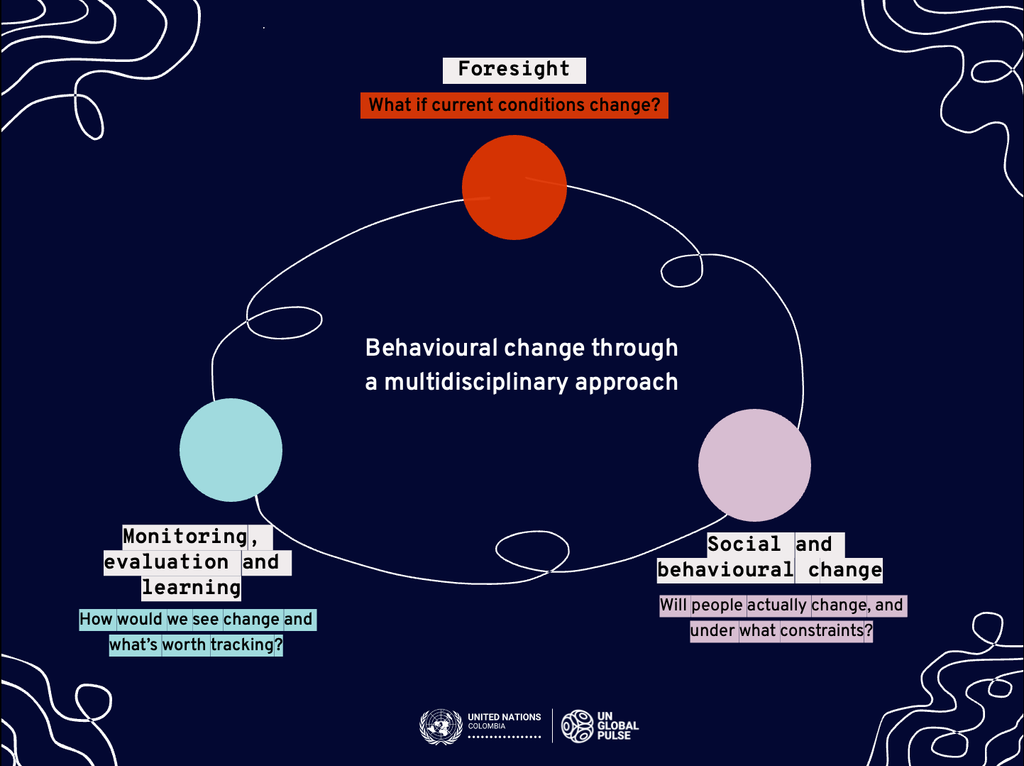
In other words, how was the Localization Initiative changing the behaviour of the people taking part in it? To tackle this, UN Global Pulse’s MEL and Social & Behavioural Change teams raised three critical, multidisciplinary questions about the initiative and the behaviours it depends on:
- A foresight question: What if current conditions change?
- A behavioural science question: Will people actually change, and under what constraints?
- An evaluation and learning question: How would we see change and what’s worth tracking?
These questions are intertwined, constantly reshaping what the other needs to answer. What we could imagine about the future shaped which behaviours we looked for, and what we saw in behaviour shaped what we tracked. We asked these questions together at the design stage, hoping to build monitoring frameworks that could tell us early whether collaboration was taking hold, and help the RCO adapt if it was not.
Working across our own siloes to understand change
To answer the questions we asked at the outset, we believed assessing change requires behavioural thinking, a core philosophy at UN Global Pulse. We do this by thinking on multiple levels: because behaviour sits within changing social systems, we must consider conditions in both the short and the long term. Behaviour is also complex and often opaque, requiring a creative, participatory and inquisitive lens to tease out how, when, and why change occurs.
In our collaboration with the Resident Coordinator’s Office in Colombia, our approach took the following shape: three methods, each answering one of the questions above and handing something to the next. Scenarios tested the Localization Initiative’s Theory of Change against possible futures. Personas helped us understand who the change depends on, and the COM-B (Capability, Opportunity, Motivation–Behaviour) model helped us diagnose what enabled or blocked their behaviour. Together, these informed the monitoring framework, as described below.
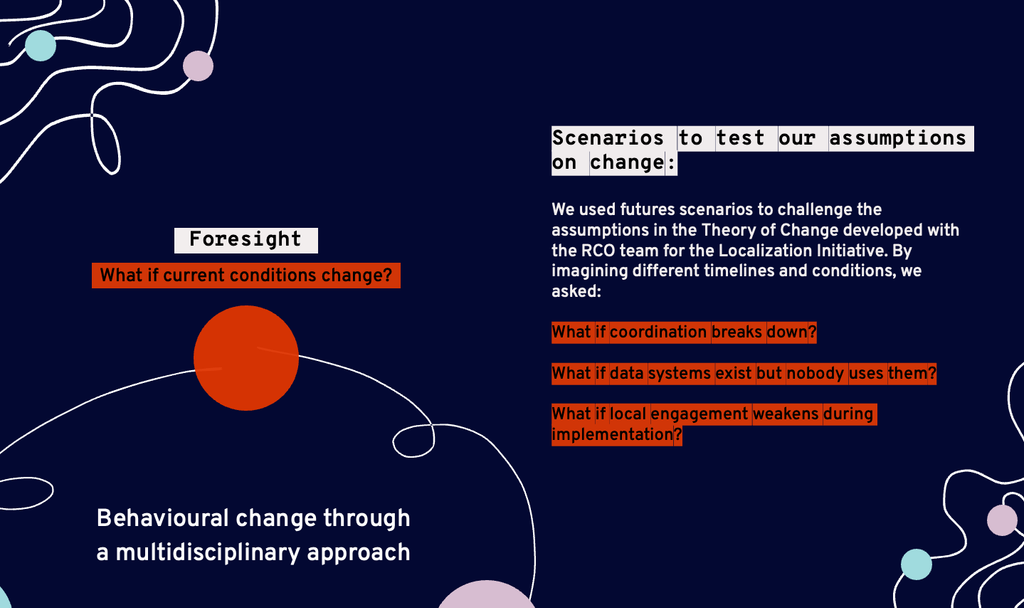
- Scenarios to test our assumptions on change: We used futures scenarios to challenge the assumptions in the Theory of Change developed with the RCO team for the Localization Initiative. By imagining different timelines and conditions, we asked, “What if coordination breaks down? What if data systems exist but nobody uses them? What if local engagement weakens during implementation?”
This kind of divergent thinking was familiar to the RCO, which worked across territories with very different realities. Looking across multiple timelines helped surface early signals the plan alone might miss, including coordination gaps, friction in adopting tools, and data-sharing fatigue. Scenarios showed us what might go wrong and when, but not who would be affected or why. For that, we turned to the people involved.
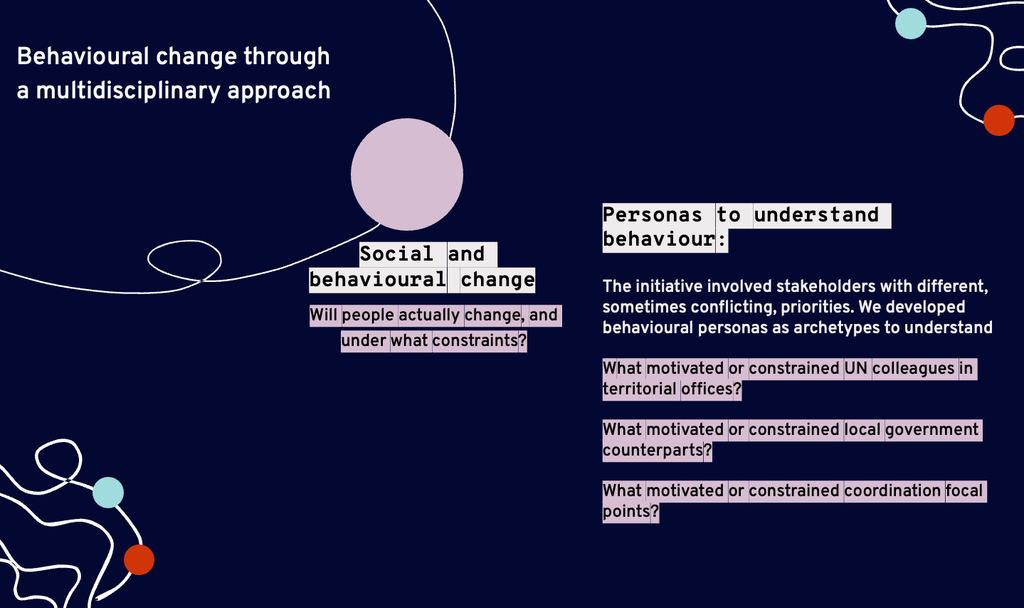
- Personas to understand behaviour: The initiative involved stakeholders with different, sometimes conflicting, priorities. We developed behavioural personas as archetypes to understand what motivated or constrained UN colleagues in territorial offices, local government counterparts, and coordination focal points.
Personas revealed the pressures shaping decisions and what the initiative required of people beyond its idealized pathway to change. But they did not tell us which pressures were actually blocking collaboration. To find that out, we needed a diagnostic.
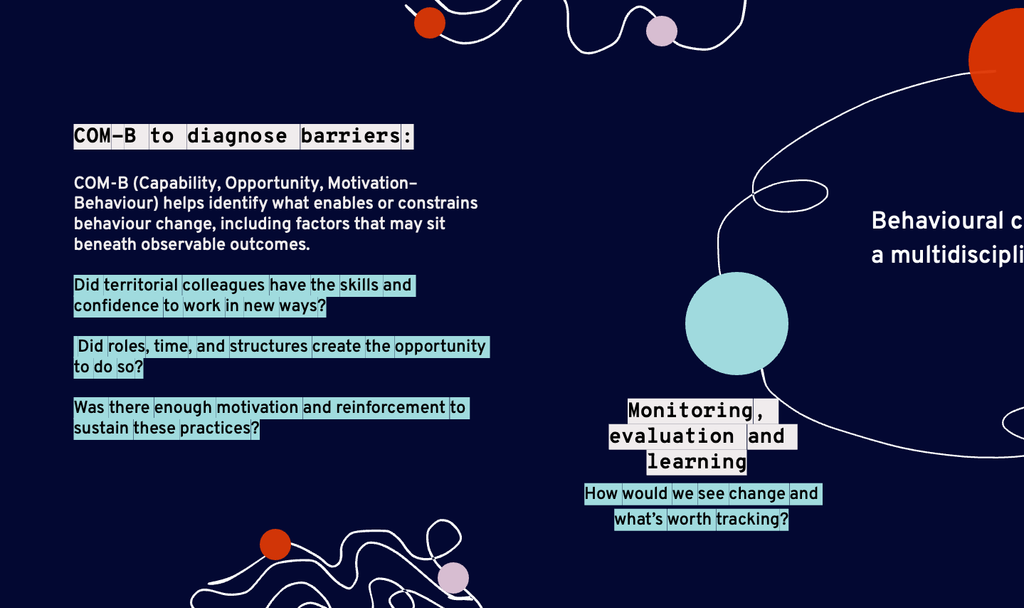
- COM-B to diagnose barriers: COM-B (Capability, Opportunity, Motivation–Behaviour) helps identify what enables or constrains behaviour change, including factors that may sit beneath observable outcomes.
We used it to ask: Did territorial colleagues have the skills and confidence to work in new ways? Did roles, time, and structures create the opportunity to do so? Was there enough motivation and reinforcement to sustain these practices?
What changes when we center behaviour in how we understand impact?
Centering behavioural change in how we looked for and measured impact was an important shift in understanding, and it changed how we designed the collaboration. This project with the RCO in Colombia brought important, anticipatory questions into the process early enough to shape how we wanted to monitor and evaluate impact.
This made the project a multidisciplinary exercise – approaching the same challenge from different angles. We asked whether people are coordinating differently after workshops, and what would need to happen for that to continue. We asked who is actually using a newly introduced framework, what is stopping those who are not, and whether that says something about the design or the conditions around it.
That way of thinking shaped the MEL framework itself. A key result was the behavioural assessment scorecard, which translated what emerged from the personas and COM-B diagnostic into something trackable, bringing the conditions behind behavioural change into the measurement system rather than treating them as context outside it. The result was a MEL framework that made behaviour part of the measurement itself.
Why this travels past one country office
We view our collaborative project with the Resident Coordinator’s Office as a possible archetype for other Resident Coordinator’s Offices and UN Country Teams. This means the same question will recur as planning processes shift from top-down to participatory: is the collaboration it depends on actually taking hold, beyond what it looks like on paper?
This project shows that design depends on behavioural, social, and institutional conditions, and a foundation that must be built strategically and empathetically.
When behavioural science and foresight meet monitoring and evaluation frameworks, we can then start to change what a system can actually do. Assumptions stop hiding in the arrows of a chart and become testable under identified conditions, with a built-in signal that tells you when they fail. Behavioural and structural risks surface in real time, not in an endline evaluation when it is too late to act. And teams have room to adapt when a signal appears, making the process iterative.
More broadly, this is also where the work connects to the overall UN 2.0 and UN80 transformation agendas. The UN 2.0 transformation toolkit puts behavioural science and foresight alongside data, digital, and innovation, and the UN80 Initiative calls on the UN system to show how it translates action into impact while combining resources and becoming more efficient.
This is the philosophy UN Global Pulse takes into every project: start with behaviour while looking at the system around it. People’s actions and perceptions are shaped by social norms, relationships, power, institutions and incentives, so we ask what needs to change, and what conditions make that change possible, meaningful and sustainable. We treat change as something that evolves, using foresight to question today’s assumptions, and participation to ground the work in the knowledge of the people within those systems, including whose knowledge counts and whose vision of change we’re designing for.
Colombia is our experiment for that philosophy. If a territorial planning initiative can measure collaboration, trust, and the conditions behind them from day one, then the people it depends on can own, sustain, and evolve the transformation. In our next blog in this series, we will share more about how this approach and framework is adapted, and the emerging results and learning from its implementation.