



How can the United Nations plan more effectively and efficiently in territories shaped by conflict, inequality, climate vulnerability, migration pressures, and shifting realities?
For many years, the UN system has made significant progress in joint planning through the UN Cooperation Framework. But in Colombia, like many other countries, much of that planning remains largely at the national level. Most programmatic decisions are made centrally by the UN Country Team, often shaped by donor conditions and funding requirements. As a result, projects arrive already predefined in the territories, with limited flexibility to adapt to local realities.
This top-down approach makes it difficult to align interventions with the specific needs and characteristics of each territory – that is, the regional or local jurisdiction within a state, including provinces and departments. It affords little room to adjust priorities or design context-specific solutions once implementation begins.
In addition, fragmentation across UN agencies is a major challenge. Each agency typically operates according to its own mandate, objectives, and funding streams, leading to a proliferation of disconnected projects at the local level. In some cases, this even results in duplication of efforts. While coordination mechanisms exist for humanitarian response, there is no equivalent system for development programming. A recent UN SDG Cooperation Framework evaluation report for Colombia further details fragmented implementation due to territorial complexities and multi-actor coordination challenges, which hardly allow for the operationalisation of joint planning.
This lack of integration and absence of a coordinated, system-wide approach hinders the overall efficiency, effectiveness, and coherence of UN support in the territories.
But the problem of joint planning and coordination is not peculiar to Colombia. A United Nations report on System-wide evaluation on progress towards a “new generation of United Nations country teams” underlines a stark “gap between vision and reality”, revealing that although the UN Cooperation Framework has led to improved alignment in country-level planning, it has not “significantly influenced substantive programming decisions or become the most important planning and implementation instrument for the United Nations at the country level”. The report also reveals widespread structural barriers, including weak incentives for collaboration, fragmented governance systems, and agency-specific accountability systems that limit the effectiveness of integrated country teams. These global, system-wide complexities corroborate the weaknesses in Colombia’s local joint planning.
Within the United Nations system, Resident Coordinators and their Offices exist specifically to solve this problem by bringing together the different UN agencies to enhance the efficiency and effectiveness of operational activities at the country level while supporting the UN’s response to national priorities. In Colombia, the Resident Coordinator’s Office (RCO) strategically positions itself not just to perform the coordination functions and address the challenges therein, but also to tackle the issue of top-down programming, in line with the tenets of UN80 reform and with a bigger focus on scale and impact.
Why Traditional Planning Approaches Are Not Enough
According to the Resident Coordinator’s Office in Colombia, traditional planning approaches do not account for Colombia’s high level of territorial diversity and inequality. While national-level planning often assumes relatively uniform solutions, regions such as Cauca (which combines high ethnic diversity with persistent armed conflict and displacement), Guaviare (a hotspot of deforestation and illicit economies), and La Guajira (with chronic humanitarian conditions) have very different social, economic, and institutional realities. A one-size-fits-all approach simply does not work in such heterogeneous and dynamic contexts.
In practice, many programmes are designed in the country’s capital, Bogotá, based on national-level discussions with donors and government counterparts, then applied uniformly across regions. However, once implemented, it becomes clear that these interventions do not always match local needs or priorities.
As the Resident Coordinator’s Office (RCO) team in Colombia explained:
“You plan in Bogotá what you think the territories need – with very limited flexibility to adjust based on local realities. But when you go to each territory, they are so heterogeneous, with such different characteristics and needs, that maybe that solution doesn’t apply.” – Natalie Gomez Arteaga from the RCO.
Another key limitation is the insufficient involvement of local governments in the planning process. While the UN has experience engaging communities, local authorities, such as mayors and governors, are not consistently placed at the centre of development planning.
Structural funding constraints also constrain flexibility. Many programmes are tied to specific donor priorities, themes, and target populations, which restricts the ability to adapt interventions to different territorial contexts. Given the diversity of regions such as Cauca, Guaviare, and La Guajira, which have the country’s worst humanitarian and socioeconomic indicators compared to other regions, greater flexibility and locally-driven planning processes are essential to achieving meaningful impact.
Lastly, the absence of a common vision and a system-wide strategic thinking approach contributes to a disintegrated territorial planning focus. All of these created an opportunity and a need for a new way of working and planning.
A New Model: Localization in Action
In response to the identified challenges with traditional territorial planning approaches, the Resident Coordinator’s Office (RCO) in Colombia launched the Cooperation Framework (CF) Localization Initiative, which is an effort to bring UN planning closer to the territories it seeks to serve, strategically aiming to result in a shift in how the UN collaborates, learns, and delivers impact locally. The initiative was designed to shift planning from a top-down exercise towards a more participatory, systems-oriented process, allowing territories to identify their own priorities and shape programmes accordingly.
How does this initiative work on the ground?
At its core are the Territorial Action Plans (Planes de Acción Territorial, or PATs), developed jointly by UN entities, local governments, civil society, private sector actors, and local communities. In each territory, a designated UN agency leads the process, taking ownership of the methodology and implementation, while the RCO provides guidance and strategic direction.
The process begins with a comprehensive data-gathering phase. The lead agency compiles information from a wide range of sources, including UN data, government planning documents, and external analyses, often drawing on more than 100 inputs. This information is organized around the four axes of the Cooperation Framework. Based on this, the RCO conducts a “problem tree” analysis, identifying three core problems per axis and their underlying causes. This creates a detailed diagnosis of the territory’s main challenges.
From there, a multi-stakeholder workshop is convened, bringing together local government, UN agencies, private sector actors, NGOs, and sometimes national-level participants to collectively prioritise the most critical root causes, especially those that cut across multiple issues.
Following this, the lead agency and RCO translate these priorities into strategic “levers for change”, essentially, positive transformation objectives that address the identified causes. These levers are then validated in a second workshop, where stakeholders also begin defining concrete actions under each lever. At this stage, an operational plan is developed outlining short-term actions (6–12 months) to initiate tangible change.
Importantly, this initiative is not only about aligning UN efforts but also about bringing together external partners who may already be working in the territory but lack coordination. The process is highly participatory, ensuring that local perspectives shape priorities and solutions throughout.
“We are really trying to get everybody together towards working on the same objective,” – Julia Fernandez Puertas from the RCO described.
A defining feature of the initiative, of course, is the strong role of local leaders. Historically, the UN has often engaged communities directly, especially in humanitarian settings, but has had fewer structured mechanisms for co-planning with mayors, governors, and local administrations. Rather than seeing local governments only as counterparts, this initiative positions them as strategic leaders in territorial development. The approach recognises that sustainable territorial progress depends on strengthening local ownership and institutions, rather than merely delivering externally designed interventions.
“They are the ones who know what their communities need. They should be in the driving seat of development plans,” – Julia Fernandez Puertas noted.
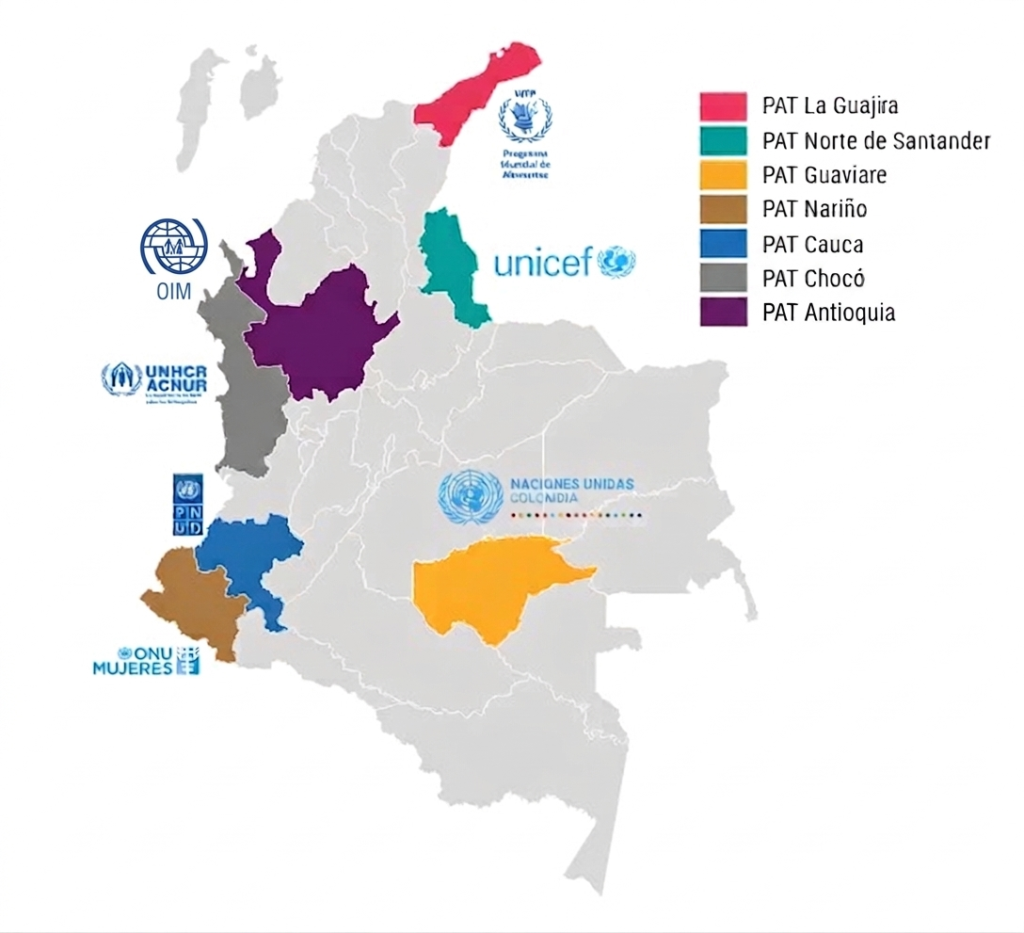
As of today, this initiative has been implemented across seven provinces, including Cauca, Guaviare, La Guajira, Nariño, Chocó, Norte de Santander and Antioquia, directly reaching 75 representatives of government, civil society, academia, and UN agencies (including UNDP, UN Women, UNHCR, WFP, UNICEF, UNODC and IOM). In the coming months, the RCO team plans to scale the initiative to more provinces to drive further impact.
UN Global Pulse Supports the Effort
In 2024, the RCO in Colombia participated in the UN Global Pulse Accelerator Programme with the intention of scaling its joint territorial planning initiative across additional regions and territories in Colombia, and perhaps internationally to other RCOs and UN Country Teams as an archetype for localization.
As implementation advanced, the RCO faced a critical question: How do we measure whether a new way of planning is actually changing how organizations behave and collaborate?
Traditional monitoring and evaluation systems were useful for tracking outputs and activities. But they were less equipped to capture shifts in coordination cultures, trust, incentives, decision-making, or interagency behaviour.
Continuing its support for the RCO, UN Global Pulse partnered with the RCO in a collaborative project to strengthen the initiative’s learning architecture and evidence base, building a monitoring and evaluation framework that combines quantitative and qualitative analysis to assess both results and ways of working. Specifically, the collaboration helped the RCO to:
- Develop a Theory of Change for the Localization Initiative
- Define meaningful indicators linked to outcomes and impact
- Define systematic ways to capture changes in behaviours and perceptions.
This approach effectively shifted the focus from monitoring what data is available to deliberately defining what should be measured to assess impact and then working toward filling those data gaps.
“Before, we monitored what we could monitor”, Natalie Gomez Arteaga reflected. “Now we ask: what result do we want, what impact do we want, and what do we need to measure?”
The Theory of Change process led by UN Global Pulse, in particular, helped to bring coherence to this rapidly evolving initiative. According to the RCO, it provided a clearer structure for how different activities connect to outcomes; better alignment between implementation, evidence, and strategy; and a more complete picture of the initiative’s multiple dimensions. That clarity has proven useful for positioning the initiative internally and externally, and strengthening momentum for scaling.
Reflecting on the significance of the RCO’s collaboration with UN Global Pulse, Juan Camilo Munevar, the Head of the Resident Coordinator’s Office in Colombia, said:
“This collaboration showed the value of connecting global innovation and methodologies with very concrete territorial realities. UN Global Pulse helped us strengthen how we measure, understand, and learn from interagency territorial work, particularly through the Theory of Change and behavioural MEL approach. This made it possible to translate complex coordination and localization processes into practical tools and evidence that can support both local action and broader UN system learning.”
How Coordination is Changing
Although it’s still early to fully determine, some of the strongest results are already visible in behaviour and organizational culture.
At the territorial level, there is a noticeable increase in willingness to collaborate. In many cases, agencies operating in the same territory were not fully aware of each other’s work. Simply fostering that visibility and initiating regular communication is a significant step forward.
There are also similar signals at the UN Country Team level. Resident Coordinators and agency representatives express strong endorsement of the initiative as a vehicle for stronger collective action.
More importantly, agencies are beginning to think differently about designing projects, asking how new interventions can align with shared territorial priorities rather than operating in silos. This may seem simple, but it suggests an institutional shift from parallel programming towards strategic alignment for efficient and effective service delivery in line with the UN80 vision.
Why This Matters Beyond Colombia
The Colombia experiment points to a broader lesson for the United Nations system: Localization is as much about moving planning closer to communities as it is about changing incentives, behaviours, and decision-making structures within institutions. While plans and funding matter, systems change depends largely on whether (or not) organizations can learn, adapt, and act together.
That is precisely where the RCO Colombia’s initiative, supported by UN Global Pulse, is generating value: by combining practical territorial planning with evidence, behavioural insight, and systems thinking.
As the United Nations advances its UN 2.0 and UN80 transformation agendas, Colombia offers an important example of what that can look like in practice – creating a more agile, coherent, responsive, and locally grounded United Nations delivering in (and for) the territories that need it the most.
Learn more about the RCO Colombia Project.
This blog was written by Hillary Nwoziri, Communications Specialist at United Nations Global Pulse, with input and responses from the RCO Colombia focal points – Julia Fernandez Puertas and Natalie Gomez Arteaga.